An assumption test is a structured activity that we do to evaluate the risk in an assumption.
For desirability and usability assumptions, we are typically designing activities that allow us to evaluate customer behavior.
For feasibility assumptions, we are typically conducting engineering activities that allow us to understand how difficult something might be to build.
Assumption testing makes it clear that we’re testing a single assumption and not the whole idea. These tests are faster and take less work.
How to find assumptions ?
- Create Story maps for each of your potential solutions.
- Use those story maps to generate desirability, usability, and feasibility assumptions.
- Generate ethical assumptions by evaluating your Persona and by doing a data audit.
- Viability assumptions by walking the lines of your opportunity solution tree and how to generate
- Ruthlessly prioritize what assumptions to test first.
See this video: Identifying hidden assumptions
How to write good assumptions for testing
- Be specific. The more specific your assumption is, the smaller and faster the test will be. Tie each assumption to a specific test in your story map.
- Phrase your assumptions such that they need to be true for your idea to succeed. For example, if your app requires a login, then you might generate the following assumption: Users will be willing to create a new login.
Do you need to test all of your assumptions?
No, as long as you are engaging with your customers on a regular basis, most of your assumptions will not carry much risk. They will be mostly safe.
We only need to test the riskiest assumptions that could torpedo our ideas or cause harm to our customers or company.
evaluate assumptions based on two factors:
- How important the assumption is to the success of the idea.
- How much evidence you already have for the assumption.
Our riskiest assumptions are the assumptions that are critical to the success of our idea where we have little evidence that suggests that they are safe.
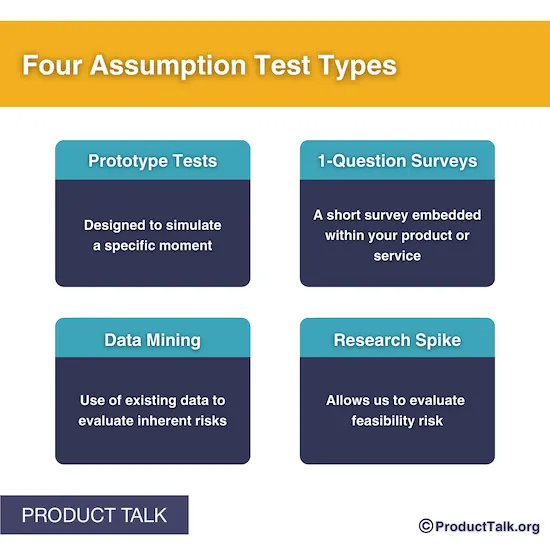
4 Types of assumption tests
Categories of assumptions
Assumptions fall into five categories:
- desirability
- feasibility
- usability
- viability
- ethical
What do you do if an assumption test fails?
Get used to it. This is going to happen a lot. And it’s perfectly normal. Many (if not most) of our tests will fall short of our expectations.
The advantage of running assumption tests instead of whole idea tests is that when an assumption test fails, we now know exactly what to do.
When we test a whole idea and it fails, all we know is that it didn’t work, but we don’t always know why. When an assumption test fails, we know exactly what needs to change
Process to start assumption testing in your company
Most teams can start assumption testing without waiting for permission. For example, if you have access to data sources like user behavioral analytics, support tickets, sales notes, customer interview transcripts, or any other data sources that hint at customer behavior, you might be able to start doing some data mining tests right away.
If you work in an organization where you don’t have any access to customers, running prototype tests might be hard. I’d befriend someone on the account management team, the support team, or the sales team and see if you can run some quick prototype tests with the folks they are already talking to.
Your engineers can usually create engineering prototypes or run research spikes as part of your regular delivery cycle. This could be as simple as creating a user story and adding it to your next sprint. If your sprints are already jam-packed, start with something teeny tiny to start building this muscle.
When should you run assumption tests?
Assumption testing helps us compare and contrast multiple solutions against each other. So I like to run assumption tests after I’ve chosen a target opportunity and selected three potential ideas to explore.
I also like to use assumption testing after I’ve chosen a final solution candidate if I still have open questions about how the solution should work or if there’s more risk to mitigate.
Assumption testing is a discovery activity that should be used when trying to decide what to build. A team that does continuous discovery is continuously running assumption tests.
What tools should you use to test your assumptions?
There are a number of tools that make assumption testing easier and faster. I like to have the following types of tools in my toolbox:
- An unmoderated testing platform: These tools allow us to upload a prototype, go home for the day, and come back to a set of videos of what customers did with the prototype. UserTestinginnovated in this space. Maze is another popular platform.
- In-product survey tool: Any tools that allows you to embed a short survey inside your product or service works. Qualarooinnovated in this space and Ethnio was a fast follower. But there are now dozens of tools that do this. I use Typeform for my one-question surveys.
- User behavioral analytics tools: Anything that lets you see what your customers did while using your product or service works. There are dozens of tools in this space. Amplitude, Mixpanel, and Heap are a few of the popular ones.
- Prototyping tools: It’s getting easier and easier to create quick mockups. Balsamiq really innovated on making prototype creation easy. Sketch and Figma and a wide variety of no-code tools are also good options here.
- Data synthesis tools: Product teams are inundated with data inputs from sales notes, call-center transcripts, customer support tickets, NPS surveys, marketing insights, and so much more. Any tool that helps you make sense of all of these sources is a great one to have in your toolbox. This is the area where I’m hoping to see big gains quickly due to the rise of generative AI.
We now have hundreds of tools that can help us run assumption tests easier and faster. Pick the tools that work for your team. If you need some inspiration, check out our Tools of the Trade category on the Product Talk blog.
Source : https://www.producttalk.org/2023/10/assumption-testing/