Personas are not real people… they are hypothetical archetypes of actual users, defined with significant rigor and precision — Cooper 1999
Les Persona et mindset sont des documents visuels utilisés en UX Research qui représentent ta Cible et racontent son histoire, ses problèmes, sa situation…
Ils sont utilisés pour Comprendre ce que les gens veulent dans une entreprise.
In the 1990s, it’s probably fair to say that many design teams had never spoken to their users, and possibly didn’t even know who they were. Recognising this problem, Alan Cooper (a Software Designer and Programmer) created the concept of personas to discourage teams from designing using assumptions and an ‘elastic’ view of their audience that could change from day to day.
Enjeux des Persona
Les personas servent à ce que toutes les équipes aient une représentation précise de la Cible et de ses Besoins.
L’enjeu du Persona est d’être mémorable, de bien représenter la cible, de rendre ses problèmes Clairs et donc de permettre de construire des solutions à ses problèmes.
À cause de cet enjeu, nous proposons une nouvelle manière de construire un Persona :
- Raconter une histoire de la personne typique qui accumule tous les problèmes possibles. Une seule personne suffit parfois, qui vit différents moments de vie . Tout le monde peut s’identifier et elle couvre les besoins de nombreuses personnes. Raconter cette histoire est crucial car c’est mémorable et émotionnel.
- Créer des quickcards, auxquelles les équipes ont accès pour retrouver les points cruciaux :
- Les points d’intérêt du personnage (ce à quoi il fait attention)
- Les points problématiques que le personnage rencontre
- Les capacités et ressources actuelles du personnage
Idées originales Antonin Adert + Jessica P.
Persona vs. Jobs-to-be-done
The usability of any given design can only be assessed relative to two variables: who are the users and what do they need to do? That’s why it’s critical for the validity of a usability study to recruit representative test users and give them representative tasks to perform. A particular design may be great for one category of users and terrible for another category of users, so if you test with the wrong users, the test results won’t tell you anything about real use. For that exact reason, we need to specify both the target audience and their goals during the design process, so that we don’t design for the wrong users or create the wrong features. Users and tasks: we need both for a UX process to be successful.
See https://nngroup.com/articles/personas-jobs-be-done/
Persona vs. User roles
A user role, in contrast to personas, does not look or sound like a real person; it’s an abstraction — a relationship, not a person, title, job, description or function. It is defined as a set of characteristic needs, interests, behaviors, and expectations. — Constantine and Lockwood 2001
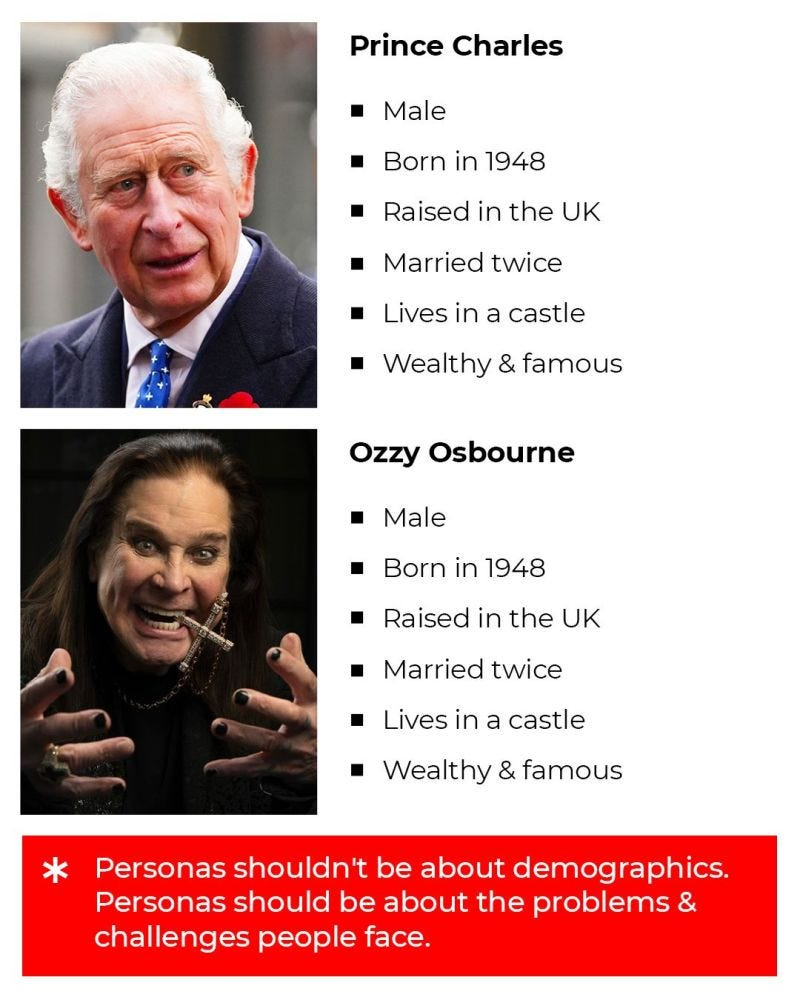
Le persona n’est pas à propos des demographics
Voici le contre-exemple:
Persona mindsets
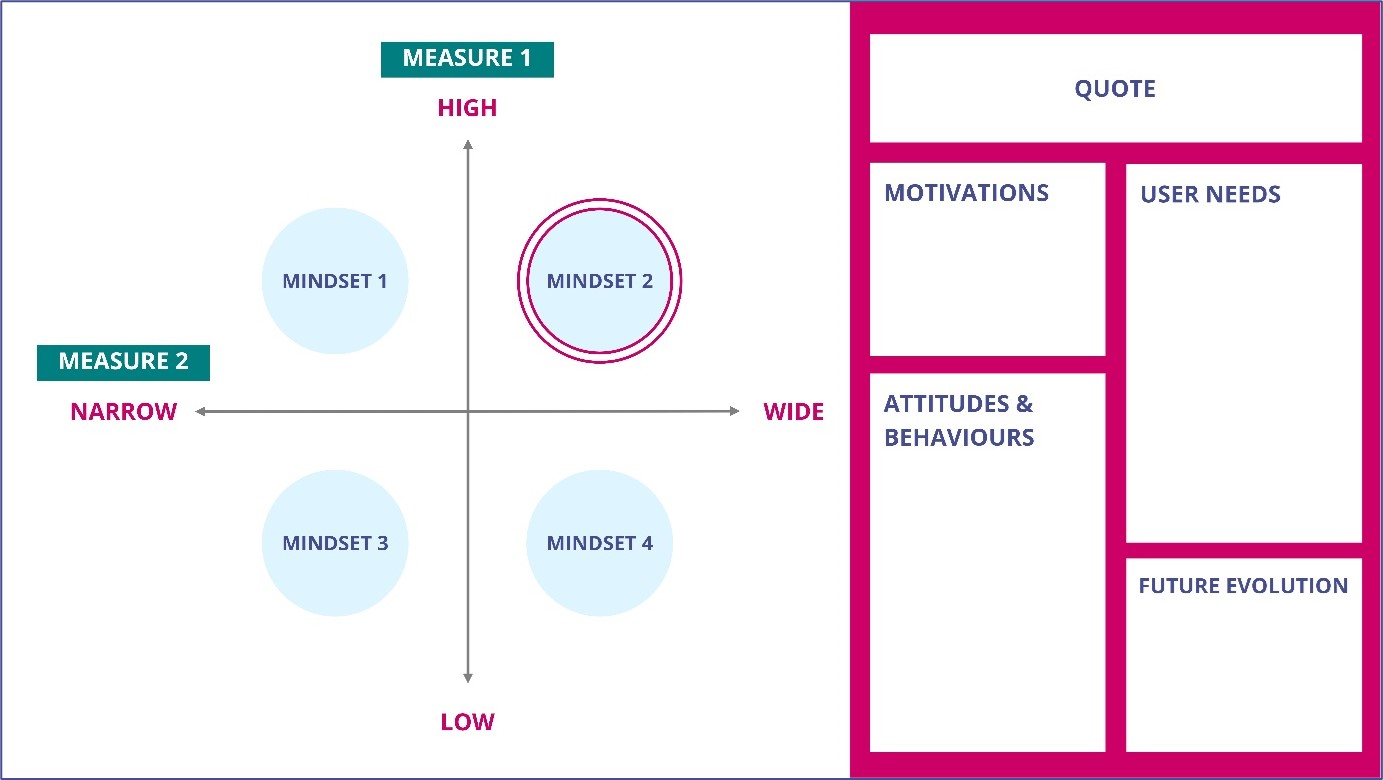
Mindsets are all about attitude and tend to have an impactful, suggestive label that encapsulates this for each group – think ‘Conscious balancers’ or ‘Stuck on a rollercoaster’.
The detail behind each mindset also includes behaviours and needs, as well as the drivers for these (which may vary) and potential evolution of the mindset in the future. Mindsets offer a broader view of user thinking and are commonly used as a conversation starter for big concepts
Classic personas
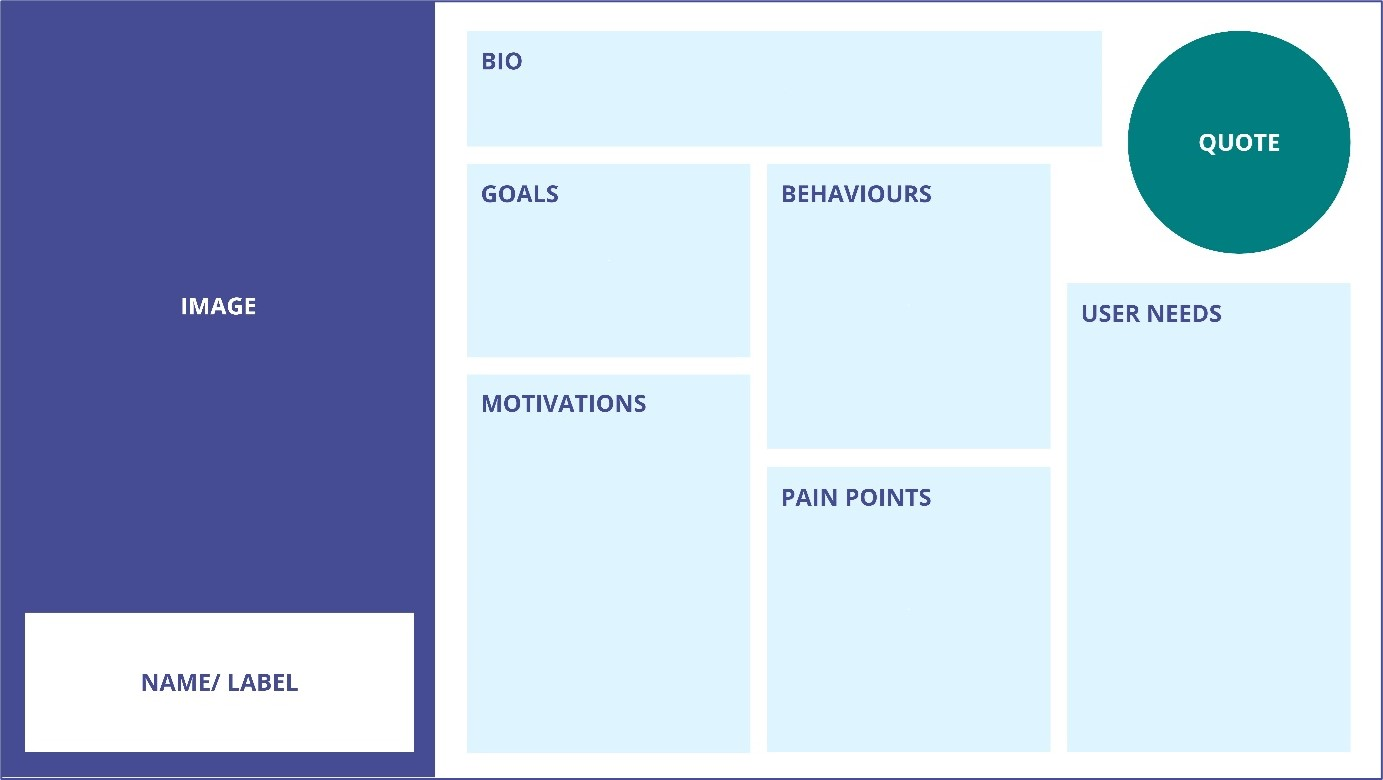
Personas capture the needs, behaviours, goals and pain-points of a user group, under the pretext of a single individual. They should be highly relevant to the product or service being developed and based on real insights from user research.
Whilst personas should be positioned as an evolving tool that is enriched through ongoing research, it is true that they can appear as fixed users – a perception that is difficult to change.
Also, the picture of the user encourages stereotyping bias.
Ressources persona
Livres : The persona lifecycle
Source : https://www.system-concepts.com/insights/are-mindsets-the-new-personas/