Quand tu fais un projet en équipe, voici les clés selon une longue recherche de Google qui s’appelle re:work :
Pod. Work group. Committee. Autonomous collective. Whatever you call it, you’re part of one at Google and probably wherever you work: a team. So if we know what makes managers great, why don’t we know what makes a team great?
A group of us in Google’s People Operations (what we call HR) set out to answer this question using data and rigorous analysis: What makes a Google team effective? We shared our research earlier today with the Associated Press, and we’re sharing the findings here, as well.
Over two years we conducted 200+ interviews with Googlers (our employees) and looked at more than 250 attributes of 180+ active Google teams. We were pretty confident that we’d find the perfect mix of individual traits and skills necessary for a stellar team — take one Rhodes Scholar, two extroverts, one engineer who rocks at AngularJS, and a PhD. Voila. Dream team assembled, right?
We were dead wrong. Who is on a team matters less than how the team members interact, structure their work, and view their contributions. So much for that magical algorithm.
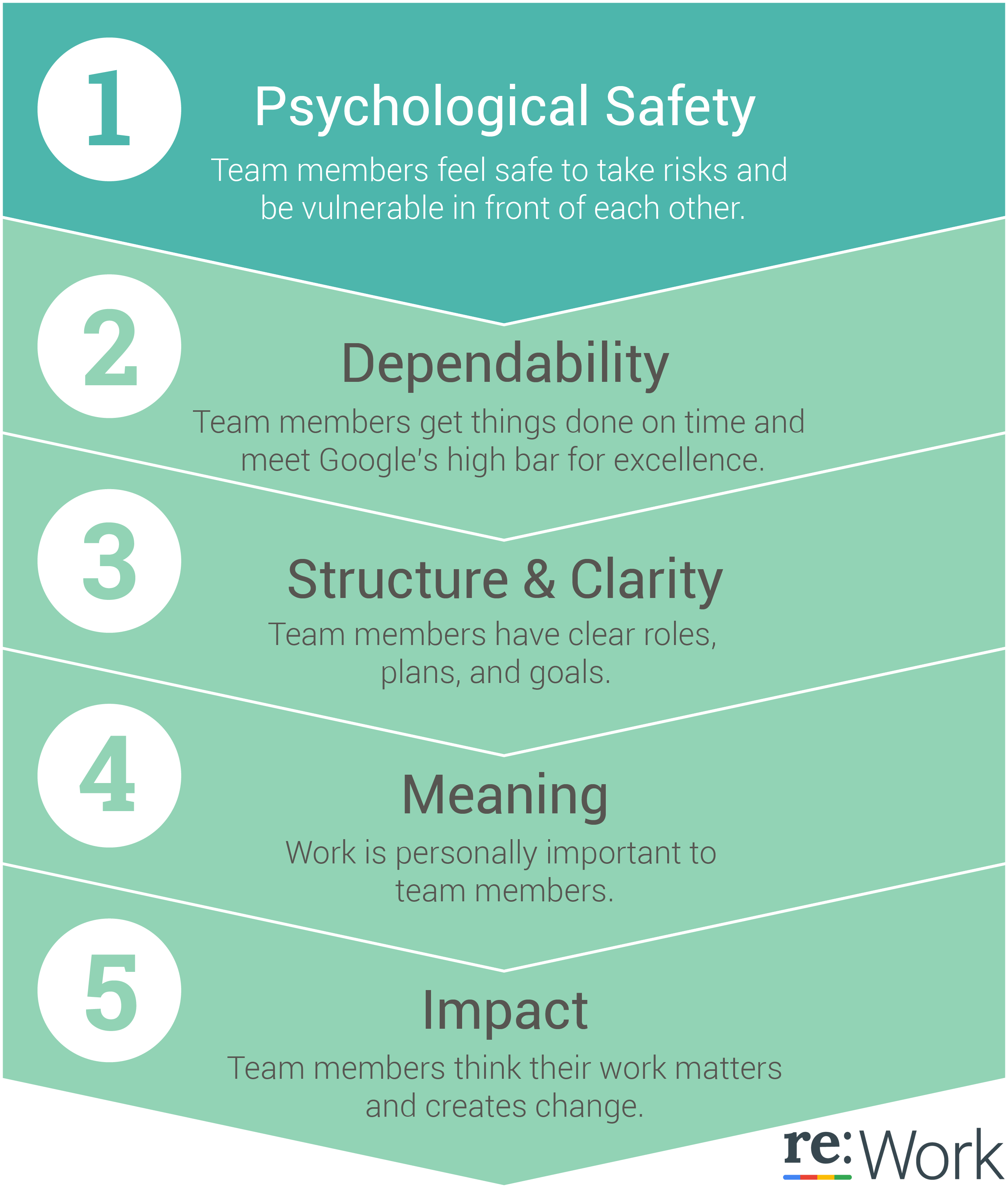
We learned that there are five key dynamics that set successful teams apart from other teams at Google:
- Psychological safety: Can we take risks on this team without feeling insecure or embarrassed?
- Dependability: Can we count on each other to do high quality work on time?
- Structure & clarity: Are goals, roles, and execution plans on our team clear?
- Meaning of work: Are we working on something that is personally important for each of us?
- Impact of work: Do we fundamentally believe that the work we’re doing matters?
If you answered “yes” to the five questions above, congrats! You’re probably on a high-performing team. And if not, not all hope is lost. This is a shortcut to help you figure out where to focus, how to get better, and a way to talk about this concept with your teammates in a structured way.
Psychological safety was far and away the most important of the five dynamics we found — it’s the underpinning of the other four. How could that be? Taking a risk around your team members seems simple. But remember the last time you were working on a project. Did you feel like you could ask what the goal was without the risk of sounding like you’re the only one out of the loop? Or did you opt for continuing without clarifying anything, in order to avoid being perceived as someone who is unaware?
Turns out, we’re all reluctant to engage in behaviors that could negatively influence how others perceive our competence, awareness, and positivity. Although this kind of self-protection is a natural strategy in the workplace, it is detrimental to effective teamwork. On the flip side, the safer team members feel with one another, the more likely they are to admit mistakes, to partner, and to take on new roles. And it affects pretty much every important dimension we look at for employees. Individuals on teams with higher psychological safety are less likely to leave Google, they’re more likely to harness the power of diverse ideas from their teammates, they bring in more revenue, and they’re rated as effective twice as often by executives.
Source : https://rework.withgoogle.com/blog/five-keys-to-a-successful-google-team/
Liens : Culture d’entreprise Business Entreprendre Productivité Sûreté psychologique